
Register your office to receive a $50 credit towards your first case.

How to Choose a Cohesive Bandage Manufacturer in 2026?

Choosing a reliable Cohesive Bandage Manufacturer in 2026 requires more than comparing prices and product photos. These bandages must provide consistent compression, secure adhesion, comfortable wear, and dependable performance during real use. A weak purchasing decision can create uneven wrapping, slipping edges, or unnecessary product waste.

Look for evidence, not promises. An experienced manufacturer should explain its materials, production controls, testing methods, and batch traceability clearly. Ask for samples and inspect them by hand. Notice the fabric texture, stretch recovery, powder residue, packaging quality, and tear behavior. Request relevant quality certifications, technical documents, and recent inspection records. A trustworthy supplier should answer specific questions without avoiding details.

Experience matters.

Speak with manufacturers that understand hospitals, sports clinics, pharmacies, and emergency-care distributors. Their product range should match your needs, whether you require latex-free options, different widths, private labeling, or stable international shipping. Evaluate communication speed, minimum order quantities, lead times, and how complaints are handled. A low quotation may hide inconsistent raw materials or delayed support. However, a higher price does not automatically prove better quality. That assumption deserves caution. No supplier is perfect, and even experienced buyers can overlook small warning signs. Compare actual samples, verify documentation independently, and record every decision. The right Cohesive Bandage Manufacturer should offer reliable products, transparent processes, and practical cooperation throughout the relationship.
How to Choose a Cohesive Bandage Manufacturer in 2026?

What Is a Cohesive Bandage and How Does It Work?

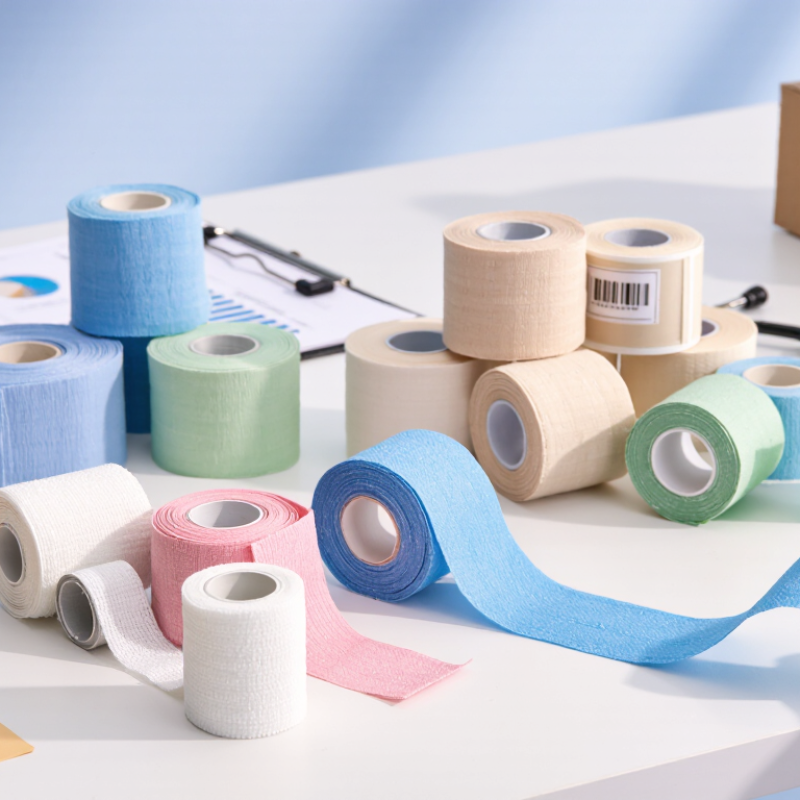
A cohesive bandage is an elastic wrap that clings to itself, not directly to skin or hair. Its fibers create gentle surface friction, allowing the layers to hold together without clips or adhesive tape. When wrapped around a dressing or joint, it provides light support and helps keep the dressing in place.

The bandage works best when applied with steady, moderate tension. Too much tension may restrict circulation, while loose wrapping can slip during movement. In practice, a worker should check the fingers or toes for normal color, warmth, and sensation after application. Small details matter. A breathable fabric can improve comfort, but breathability alone does not prove product quality.

When choosing a cohesive bandage manufacturer in 2026, request test data for stretch recovery, tear strength, skin contact safety, and latex content. Ask how each production lot is inspected and traced. A reliable supplier should explain roll length, width tolerance, packaging conditions, and storage guidance clearly. A smooth roll is not enough evidence. I would also examine whether the bandage unwinds evenly, because inconsistent tension can make application difficult. My earlier assumption was that stronger cohesion always meant better performance. It does not. Excessive grip may complicate repositioning and increase waste. A careful manufacturer balances cohesion, elasticity, softness, and dependable production.

Which Manufacturer Qualifications Matter in 2026?

How to Choose a Cohesive Bandage Manufacturer in 2026?

Which Manufacturer Qualifications Matter in 2026?

A qualified manufacturer needs more than an attractive product sample. ISO 13485 certification shows a structured medical-device quality system. However, the certificate alone proves little. Ask for its current scope, audit status, and corrective-action history. The WHO Global Patient Safety Action Plan 2021–2030 reports that one in ten patients experiences harm during healthcare. More than half of this harm is considered preventable. Reliable bandage production therefore requires measurable controls, not confident promises.

Check batch traceability from incoming yarn to sealed cartons. Request test records for tensile strength, elongation, compression, lint release, and skin-contact safety. For products touching damaged or sensitive skin, review relevant ISO 10993 evaluations. The manufacturer should also validate packaging integrity, shelf life, and sterilization claims when applicable. In 2026, digital records deserve attention too. A secure system should connect raw-material lots, operators, equipment, and release decisions. It sounds technical. It prevents painful guesswork.

Tips: Visit the production floor, even by live video. Watch how workers inspect roll edges and packaging seals. Ask for a recent nonconformance example and its corrective action. A supplier that admits one weakness may be more credible than one claiming perfection. Also compare lead-time data across several quarters, not one excellent month. The 2023 ISO Survey confirms that certified management systems remain widely used worldwide, but certification does not replace product-specific evidence. This is where many purchasing teams still move too quickly.

How to Compare Materials, Sizes, and Performance Standards

How to Choose a Cohesive Bandage Manufacturer in 2026?

Material choice should match the wound-care setting, not just the lowest quote. Cotton feels soft and absorbs moisture, while polyester usually offers stronger stretch recovery. Latex-free elastic reduces allergy concerns, but it may feel less flexible on moving joints. Ask for fiber composition, coating details, and skin-contact test results. ISO 10993 testing can help assess irritation and sensitization risks. I once assumed a softer roll was automatically better. That assumption was wrong. A bandage can feel comfortable yet lose cohesion after movement.

Size and performance need measurable comparisons. Request samples in several widths, lengths, and stretch levels. Test application on a wrist, ankle, and irregular limb shape. Record unwind force, cohesion, elongation, tensile strength, slippage, and residue after removal. ASTM test methods can support repeatable tensile comparisons, while ISO 13485 certification shows a structured medical-device quality system. The World Health Organization’s Global Report on Infection Prevention and Control reports healthcare-associated infections affecting about 7 in 100 acute-care patients in high-income countries, and 15 in 100 in low- and middle-income countries. Clean production matters.

Tips: Compare at least three production lots, not one sample. Check batch records, shelf-life data, packaging integrity, and complaint handling. Ask whether performance remains stable after heat and humidity aging. A supplier may provide impressive laboratory results, but field handling can expose weaknesses. Keep your own evaluation notes. Small details matter.

How to Choose a Cohesive Bandage Manufacturer in 2026? - How to Compare Materials, Sizes, and Performance Standards

Comparison Dimension Common Options or Reference Data What to Verify with the Manufacturer Selection Consideration
Primary Fiber Material Nonwoven polyester, polypropylene, viscose, cotton, or blended constructions are commonly used. Fiber composition by percentage, fabric weight, softness, edge stability, and lot-to-lot consistency. Select the construction according to softness, breathability, strength, stretch recovery, and intended duration of use.
Elastic Component Elastic yarns may use spandex/elastane, natural rubber latex, synthetic rubber, or latex-free alternatives. Material declaration, latex status, elongation, recovery after repeated stretching, and residual compression behavior. For latex-sensitive users, require documented latex-free status and suitable material controls rather than relying only on marketing claims.
Self-Adherence A cohesive bandage should adhere primarily to itself, not function as a conventional pressure-sensitive adhesive tape. Self-adhesion or holding-force test method, performance on clean and gloved hands, and behavior under humidity or perspiration. Compare samples under identical overlap, wrapping tension, temperature, and humidity conditions.
Available Widths Common widths include approximately 2.5 cm, 5 cm, 7.5 cm, 10 cm, and 15 cm; actual ranges vary by supplier. Finished width tolerance, edge curling, width uniformity, and availability of custom widths. Narrow widths suit fingers and small areas; wider widths can reduce application time on limbs and larger body areas.
Roll Length Rolls are often specified by nominal length, such as 4 m or 4.5 m, but the measurement may be stated in relaxed or stretched condition. Relaxed length, stretched length if stated, measurement method, length tolerance, and core dimensions. Do not compare roll length until all suppliers confirm the same measurement condition.
Stretch and Recovery Stretch values are product-specific. A higher stretch rating does not automatically indicate better support or safer compression. Elongation percentage, recovery percentage, test speed, applied load, number of cycles, and permanent deformation. Choose a balanced profile that provides conformity without excessive tension or rapid loss of support.
Tensile and Tear Performance Performance depends on fiber type, fabric structure, elastic yarn, width, and finishing process. Test direction, tensile strength, tear resistance, seam or edge strength, sample conditioning, and acceptance limits. Request laboratory results using a recognized textile test method and compare only equivalent test conditions.
Breathability and Moisture Handling Open or nonwoven structures may support air and moisture vapor movement; performance varies considerably by coating and density. Air permeability, moisture vapor transmission where relevant, absorbency claims, and performance after exposure to moisture. Prioritize moisture management for extended wear, sports use, or warm and humid environments.
Skin Contact and Biocompatibility Skin-contact products may require a biological evaluation based on contact type and duration. Biocompatibility assessment or applicable testing under the ISO 10993 series, supported by material and chemical information. Confirm that evidence applies to the finished bandage, including dyes, coatings, elastics, and processing residues.
Manufacturing Quality System ISO 13485 is a widely recognized quality-management standard for medical-device manufacturing. Valid certificate scope, certification body, production site, complaint handling, change control, and traceability procedures. Verify the certificate covers the actual facility and product category rather than accepting an unrelated corporate certificate.
Risk Management Medical-device risk management is commonly structured using ISO 14971 principles. Risk analysis covering excessive compression, skin injury, latex exposure, particulate shedding, packaging failure, and misuse. Choose a manufacturer that can explain identified hazards, controls, verification activities, and post-market monitoring.
Packaging and Sterilization Status Many cohesive bandages are supplied non-sterile; sterile versions require validated packaging and sterilization processes. Sterile or non-sterile status, sterilization method if applicable, packaging integrity testing, shelf life, and storage conditions. Match the packaging and sterility level to the intended clinical use and applicable market requirements.
Regulatory Documentation Regulatory classification and documentation depend on intended use, claims, and destination market. Declaration of conformity or equivalent documentation, technical file support, labeling, intended-use statement, and market authorization where required. Evaluate compliance for the specific destination market instead of assuming that one certificate is globally valid.
Batch Consistency and Traceability Consistent width, length, color, elasticity, adhesion, packaging, and labeling are essential for repeat purchasing. Batch records, certificate of analysis, retained samples, lot coding, inspection plans, and corrective-action process. Request samples from more than one production lot before approving a long-term supply agreement.
Supplier Evaluation Score A practical comparison can score material suitability, performance, documentation, quality controls, capacity, lead time, and total cost. Ask for objective evidence for each score, including test reports, certificates, samples, production capacity, and inspection records. Use a weighted scorecard; regulatory and safety requirements should be treated as pass/fail gates rather than traded solely for a lower price.

Note: Performance values for cohesive bandages are product-specific. Always compare results obtained with the same test method, conditioning, sample dimensions, and measurement definitions.

How to Assess Quality Control, Compliance, and Supply Capacity

How to Choose a Cohesive Bandage Manufacturer in 2026?

Quality control should begin with the material, not the sales sample. Request specifications for elasticity, cohesive force, unwind performance, skin contact, and packaging integrity. Ask for batch records, test methods, calibration logs, and traceability from fabric rolls to finished cartons. A reliable factory should explain its CAPA process and complaint response time. Evidence matters. The ISO Survey 2023 reported more than 31,000 ISO 13485 certificates worldwide, but certification alone does not prove strong production control. Verify the certificate scope, manufacturing address, audit status, and covered products.

Compliance requires market-specific evidence. In the United States, the FDA Quality Management System Regulation became effective in February 2026 and incorporates ISO 13485:2016. Confirm that the manufacturer has addressed this transition. For other markets, review technical files, risk management, labeling controls, and applicable conformity assessments. The WHO Global Atlas of Medical Devices notes over two million medical device types, showing why classification and documentation deserve careful review. Do not accept generic compliance statements.

Supply capacity needs practical testing. Request monthly capacity, current utilization, minimum order quantities, lead-time records, and backup plans for fabric, packaging, and adhesive inputs. Ask whether a second production line is validated, not merely advertised. Capacity is not volume. It is repeatable output. A factory may promise rapid scaling, yet lack trained operators or inspection space. I would include a pilot order, independent testing, and a surprise documentation review. That approach costs more initially, but it exposes weaknesses before a large shipment.

How to Evaluate Pricing, Service, and Long-Term Partnership

How to Choose a Cohesive Bandage Manufacturer in 2026?

Pricing should be judged by total value, not carton price. Request quotes using identical specifications, including fabric width, stretch, adhesive performance, packaging, testing, and delivery terms. A low offer may hide higher inspection costs or inconsistent tension. Deloitte’s 2024 Global Chief Procurement Officer Survey highlights cost management and supply continuity as major procurement priorities. Ask for three years of quality records, complaint rates, and on-time delivery data. Numbers matter. Vague promises do not.

Service reveals long-term reliability. During supplier evaluations, check whether engineers answer technical questions quickly and provide clear corrective-action reports. Confirm ISO 13485 certification, traceability procedures, batch retention, and change-control methods. The WHO Global Patient Safety Report 2024 states that roughly one in ten patients experiences harm in healthcare, so dependable product control is not optional. Still, certification alone cannot prove daily performance. Request samples from multiple production batches and test stretch, cohesion, residue, and package integrity. I would not skip this step, even when the factory looks impressive.

Tips: Build a weighted scorecard: 35% quality, 25% service, 20% landed cost, and 20% continuity. Audit the production line, not only the showroom. Ask for a backup-material plan. Check response times with a small technical request. Then review the partnership quarterly, because the best supplier today may weaken after volume grows. Industry forecasts from Grand View Research indicate continued growth in medical bandages through the decade, increasing pressure on capacity and consistency. Avoid signing too quickly. Procurement mistakes become clinical headaches.

How to Choose a Cohesive Bandage Manufacturer in 2026?

A practical evaluation framework for pricing, service, compliance, and long-term partnership.

The suggested weighting reflects common medical-device procurement priorities. Compare suppliers using verified quotations, quality documents, production capacity, delivery records, sample testing, and written service commitments before making a final decision.