Register your office to receive a $50 credit towards your first case.

China Top 10 Precision Dental Manufacturing Companies?

Choosing among the China top 10 precision dental manufacturing companies requires more than comparing product catalogs. Manufacturing quality appears in small details: clean milling edges, accurate implant interfaces, stable zirconia shade, and repeatable fit across production batches. A trusted supplier should also explain its materials, equipment, inspection process, and post-production controls.

Professor Florian Beuer, a prosthodontics and digital dentistry researcher, has emphasized, “Digital dentistry is not about replacing clinicians; it is about extending their precision.” This idea reflects the purpose of precision dental manufacturing. Advanced scanners, five-axis milling machines, sintering furnaces, and validated workflows can improve consistency. However, technology alone cannot guarantee clinical reliability. Experienced technicians still matter.

This overview examines ten leading Chinese manufacturers through practical criteria. These include production capacity, material traceability, quality management, customization ability, export experience, and communication support. Certifications such as ISO 13485 may provide useful evidence, but they should not end the investigation. Buyers should request current certificates, sample restorations, inspection records, and clear tolerance data.

A ranking is never perfectly permanent. Market visibility can change quickly. A polished website may hide limited technical support. Conversely, a smaller factory may deliver excellent work with fewer international reviews. That uncertainty deserves attention. The strongest companies usually combine engineering discipline with responsive cooperation. They understand that a dental crown is not merely a manufactured object. It must fit a real patient, under real clinical pressure, with little room for error.

China Top 10 Precision Dental Manufacturing Companies?

What Defines a Precision Dental Manufacturing Company in China

What Defines a Precision Dental Manufacturing Company in China

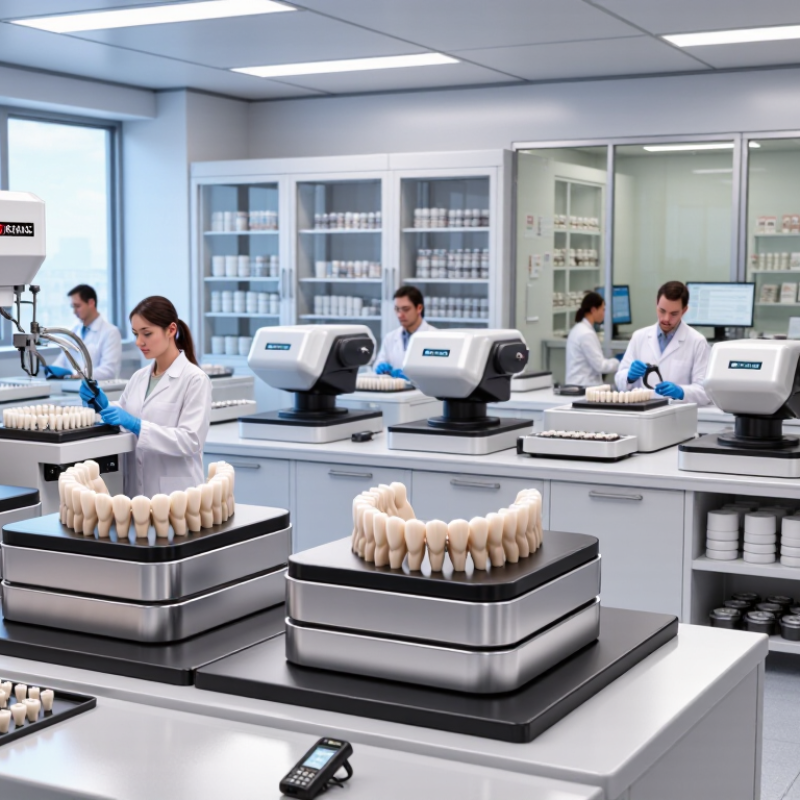
Precision begins with repeatability, not attractive product photos. A capable Chinese manufacturer converts digital scans into controlled, measurable production steps. Its workflow may include CAD/CAM design, five-axis milling, validated sintering, and documented finishing. Critical dimensions require inspection, not personal judgment. Coordinate measuring machines, optical scanners, and calibrated gauges help verify margins, contacts, and fit.

The World Health Organization’s Global Oral Health Status Report 2022 estimates that oral diseases affect nearly 3.5 billion people worldwide. China’s Fourth National Oral Health Survey reported caries prevalence above 80% among many adult groups. These figures indicate strong demand, but volume alone does not define precision. A reliable factory should provide batch records, material certificates, operator training records, and traceability from incoming materials to final inspection. ISO 13485-based quality systems are useful evidence, although certification alone cannot guarantee clinical performance.

Small details matter. A crown margin can fail because of poor scanning, not poor milling. A thin framework can distort during heat treatment. Some suppliers still overpromise tolerances without showing measurement data. That deserves scrutiny. Buyers should request sample inspection reports, tolerance ranges, remake statistics, and documented process-validation methods. Delivery speed is valuable. Stable accuracy matters more. Human review remains necessary, because digital systems can repeat an incorrect design perfectly.

China Top 10 Precision Dental Manufacturing Companies: What Defines Precision?

Precision dental manufacturers are evaluated through repeatable design, machining, sintering, inspection, biocompatibility, and material-performance controls. The chart below presents the minimum flexural-strength benchmarks specified by ISO 6872 for fixed and removable dental prosthetic materials.

Reference: ISO 6872:2015, Dentistry — Ceramic materials. Higher material classes require higher minimum flexural strength, supporting more demanding dental applications.

How the Top 10 Chinese Dental Manufacturers Are Selected

Selecting China’s top ten precision dental manufacturers requires more than comparing product catalogs or factory photographs. The assessment begins with documented quality systems, qualified technicians, and consistent production records. Evidence may include ISO 13485 certification, material certificates, calibration logs, and batch-level traceability. These details show how a manufacturer controls risk during daily operations.

Technical capability carries significant weight. Auditors should review CNC equipment, digital scanning workflows, milling accuracy, surface finishing, and inspection methods. Sample restorations can reveal margin quality, fit, occlusion, and polishing consistency. Production capacity also matters, but only when supported by realistic lead times and stable staffing. A large workshop is not automatically a dependable one.

Clinical feedback and after-sales communication strengthen the evaluation. Buyers should examine remake rates, complaint handling, packaging protection, and export documentation. Factory visits or independent audits can verify whether written procedures match actual workstations. No ranking method is flawless. A supplier may provide excellent samples yet struggle during peak demand. Another may communicate well but lack advanced inspection tools. For this reason, the top ten should reflect verified performance across quality, precision, compliance, delivery, and transparency, rather than publicity or price alone. Evidence must remain current, because equipment, personnel, and management practices can change quickly.

Profiles of China’s Top 10 Precision Dental Manufacturing Companies

China’s precision dental manufacturing sector is broad, technically capable, and uneven in quality. This profile reviews ten leading manufacturer types rather than promoting named brands. Each company is assessed through machining accuracy, material control, documentation, and clinical-use experience. Public rankings can change.

Profile One specializes in custom abutments and titanium components, using five-axis machining and lot traceability. Profile Two focuses on zirconia frameworks, with digital nesting and controlled sintering cycles. Profile Three produces orthodontic brackets and tubes, where smooth edges and consistent bonding surfaces matter. Profile Four supplies surgical guides, combining intraoral scan data with validated printing workflows. Profile Five manufactures dental burs and rotary instruments, emphasizing runout control and wear testing. Small tolerances matter.

Profile Six develops CAD/CAM discs and blocks, with attention to shade stability and fracture resistance. Profile Seven provides removable prosthetic parts, often balancing automated production with skilled finishing. Profile Eight serves laboratory clients with rapid prototyping, inspection reports, and export documentation. Profile Nine concentrates on implant-related components, requiring strict cleaning, packaging, and dimensional verification. Profile Ten integrates scanning, milling, and quality software for more connected production.

A reliable buyer should request material certificates, inspection records, sterilization information, and sample evaluations. ISO 13485 certification is useful, but certification alone cannot prove every product performs well. Factory audits should examine calibration logs, operator training, and nonconformance handling. One weakness remains: some supplier profiles rely on limited public data. That uncertainty deserves attention. Direct technical communication often reveals more than polished catalogs.

China Top 10 Precision Dental Manufacturing Companies? - Profiles of China’s Top 10 Precision Dental Manufacturing Companies

Profile Primary Manufacturing Scope Common Dental Materials Precision Production Capabilities Digital Workflow Quality and Compliance Indicators Customization Capability Typical Export Focus
Manufacturer 01 Zirconia restorations Crowns Bridges Dental zirconia, lithium disilicate, titanium, cobalt-chromium and PMMA CAD/CAM milling, multi-axis machining, sintering, staining, glazing and final inspection Intraoral-scan data processing, CAD design, nesting and digital production tracking ISO 13485-oriented quality systems commonly used in this sector Shade matching, margin adjustments, implant-platform specifications and small-batch orders Dental laboratories and distributors in Asia, Europe, North America and the Middle East
Manufacturer 02 Implant components Abutments Surgical parts Titanium alloys, commercially pure titanium, stainless steel and cobalt-chromium CNC turning, five-axis milling, threading, polishing, anodizing and dimensional inspection Digital CAD/CAM files, barcode traceability and coordinate-measuring-machine inspection Batch traceability and documented inspection procedures Custom abutment geometry, connection dimensions, surface finishing and packaging options OEM and private-label supply for dental laboratories, implant companies and clinics
Manufacturer 03 Clear aligners Retainers Night guards Medical-grade thermoplastic sheets, PETG, TPU and multilayer orthodontic polymers Thermoforming, automated trimming, edge polishing, laser marking and fit verification 3D model review, staging software compatibility and digitally archived case records Controlled material lots and process validation are standard requirements Case-based production, customized trimming lines, thickness selection and labeling Orthodontic service providers, dental laboratories and treatment networks
Manufacturer 04 Removable dentures Partial frameworks Denture teeth Acrylic resin, PMMA, nylon, cobalt-chromium and prefabricated denture teeth Digital denture design, resin processing, framework casting or milling and occlusal finishing CAD denture setup, digital articulation and structured case approval workflows Material certificates and case-level production records commonly maintained Tooth arrangement, gingival characterization, framework design and repair services International dental laboratories and institutional procurement channels
Manufacturer 05 Dental milling blanks CAD/CAM discs Blocks Zirconia, PMMA, wax, glass ceramics and composite resin materials Powder preparation, pressing or milling, coloring, sintering and batch-performance testing Digital library compatibility, material parameter documentation and lot identification Material specifications and technical data sheets are normally available Shade systems, disc thicknesses, translucency grades, packaging and private-label formats CAD/CAM distributors, milling centers and dental laboratories
Manufacturer 06 Orthodontic appliances Metal brackets Archwires Stainless steel, nickel-titanium, cobalt-chromium, ceramics and orthodontic polymers Precision stamping, laser welding, CNC forming, heat treatment and surface finishing Digital product drawings, batch coding and inspection records for key dimensions Dimensional control and material traceability are central quality indicators Prescription specifications, bracket positioning systems, wire forms and kit assembly Orthodontic distributors, clinics, laboratories and overseas OEM buyers
Manufacturer 07 Dental instruments Rotary tools Hand instruments Stainless steel, tungsten carbide, diamond abrasive, nickel-titanium and polymers Grinding, micro-machining, brazing, coating, passivation and sharpness or runout testing Digital inspection records, product coding and controlled work instructions Process control typically covers geometry, hardness, surface quality and cleanliness Shank dimensions, grit sizes, working lengths, handle designs and packaging formats Dental equipment distributors, clinics, laboratories and surgical supply channels
Manufacturer 08 Custom abutments Implant bars Full-arch frameworks Titanium, zirconia, cobalt-chromium and high-performance dental polymers Five-axis milling, sintering, laser marking, passive-fit inspection and surface treatment Implant-library integration, scan-body compatibility and digital approval workflows Case-specific design review and traceable production records Implant connections, emergence profiles, screw-channel positions and framework geometry Implant laboratories, dental clinics and full-arch treatment centers
Manufacturer 09 Dental models Surgical guides Temporary restorations Model resin, surgical-guide resin, biocompatible polymers and PMMA High-resolution 3D printing, post-curing, support removal, finishing and dimensional checks STL-file processing, print-orientation optimization and digitally archived case data Material batch control and validated printing parameters are key indicators Model types, guide sleeves, printing resolution, resin selection and case packaging Dental laboratories, hospitals, academic institutions and digital dentistry centers
Manufacturer 10 Full-service dental manufacturing OEM production Private label Zirconia, ceramics, titanium, cobalt-chromium, PMMA, acrylics and orthodontic polymers Integrated CAD/CAM, CNC machining, 3D printing, casting, sintering, polishing and assembly End-to-end digital case management, file review, production scheduling and traceability Documented quality controls are generally expected for export-oriented production Product development, packaging, labeling, technical documentation and contract manufacturing Global dental laboratories, distributors, clinics and medical-device partners

Note: Company identities and brand-specific information have been intentionally omitted. The comparison focuses on commonly documented manufacturing capabilities, materials, digital workflows and quality dimensions within China’s precision dental manufacturing sector.

Comparison of Products, Technologies, Certifications, and Capabilities

China’s top 10 precision dental manufacturing companies should be compared beyond product catalogs. Their portfolios may include dental implants, abutments, orthodontic components, milling blanks, surgical guides, and laboratory prosthetic parts. Product consistency matters more than product variety. Check dimensional tolerance, surface finish, material traceability, and batch records. Small differences can affect clinical fit.

Technology separates capable manufacturers from ordinary suppliers. Look for five-axis CNC machining, CAD/CAM integration, precision casting, laser marking, and automated inspection. Experienced teams should explain their inspection methods clearly. Ask for sample reports, not only attractive photographs. Their production capacity should match your order size without weakening quality control. Lead times also need practical testing.

Certifications provide useful evidence, but they require careful reading. Verify ISO 13485 quality systems, relevant product approvals, and destination-market documentation. A certificate may cover one facility or product range only. That detail is often missed. Review calibration records, clean production areas, nonconformance procedures, and corrective-action history. Reliable manufacturers welcome technical audits and communicate changes early. Still, no supplier is perfect. Even strong factories may show uneven documentation or occasional delivery pressure. A fair comparison should record these weaknesses, alongside engineering expertise, regulatory readiness, customization ability, and after-sales support.

Key Applications and Future Trends in Precision Dental Manufacturing

Precision dental manufacturing now connects digital scans, computer-aided design, and controlled production. Dental laboratories use these methods for crowns, bridges, aligners, implant guides, and removable prostheses. Each application demands different tolerances, materials, and surface finishes. A poorly fitted restoration can create discomfort, adjustment work, and unnecessary chair time.

Quality depends on more than advanced equipment. Experienced technicians verify scan accuracy, tool calibration, material records, and final dimensions. They also inspect margins under magnification and check contact points before delivery. Traceability supports reliable clinical decisions. Small details matter. A clean workflow matters too. Future systems will combine artificial intelligence with automated design suggestions and real-time production monitoring. Machine learning may detect distortion earlier, but it still requires qualified human review. Software can identify patterns, not patient priorities.

Additive manufacturing will likely expand for surgical guides, temporary restorations, and customized frameworks. New ceramic, polymer, and metal materials may improve strength while reducing waste. Robotic finishing could create more consistent surfaces, although maintenance and validation remain difficult. Digital production also raises concerns about cybersecurity, data ownership, and compatibility between systems. These issues are often treated as technical footnotes. They should not be. Smaller laboratories may struggle with training costs and equipment upgrades. Clinical teams must evaluate evidence, not marketing claims, before changing established workflows. Precision should mean repeatable performance, not simply tighter numbers.