Register your office to receive a $50 credit towards your first case.

What Is Precision Dental Manufacturing for Global Buyers?

For global buyers, precision dental manufacturing means more than producing crowns, bridges, implants, or orthodontic components. It combines digital design, controlled materials, skilled technicians, and repeatable inspection. A well-made restoration should fit the patient’s prepared tooth, match the approved design, and remain consistent across production batches.

In practice, buyers may review CAD/CAM workflows, milling accuracy, sintering records, and inspection reports. They may also examine zirconia certificates, cobalt-chrome documentation, surface-finish standards, and lot traceability. Small details matter. A loose margin can cause clinical adjustments, delays, and patient dissatisfaction. Clear communication matters too, especially when teams work across time zones and languages.

Reliable precision dental manufacturing depends on evidence, not attractive promises. Suppliers should explain their quality system, equipment capabilities, technician qualifications, and corrective-action process. Relevant certifications can support confidence, but certification alone does not guarantee every order will be perfect. No supplier is flawless. A careful buyer still checks samples, tolerances, packaging, lead times, and after-sales responses.

This guide explores how international purchasers can assess manufacturers with practical judgment. It considers technical performance, regulatory expectations, material control, and production transparency. Requirements differ between markets, so buyers should confirm local rules with qualified regulatory or dental professionals. The goal is not merely to find a low price. It is to find a dependable manufacturing partner that protects fit, consistency, documentation, and clinical trust. That standard is demanding. It should be.

What Is Precision Dental Manufacturing for Global Buyers?

Definition and Scope of Precision Dental Manufacturing

What Is Precision Dental Manufacturing for Global Buyers?

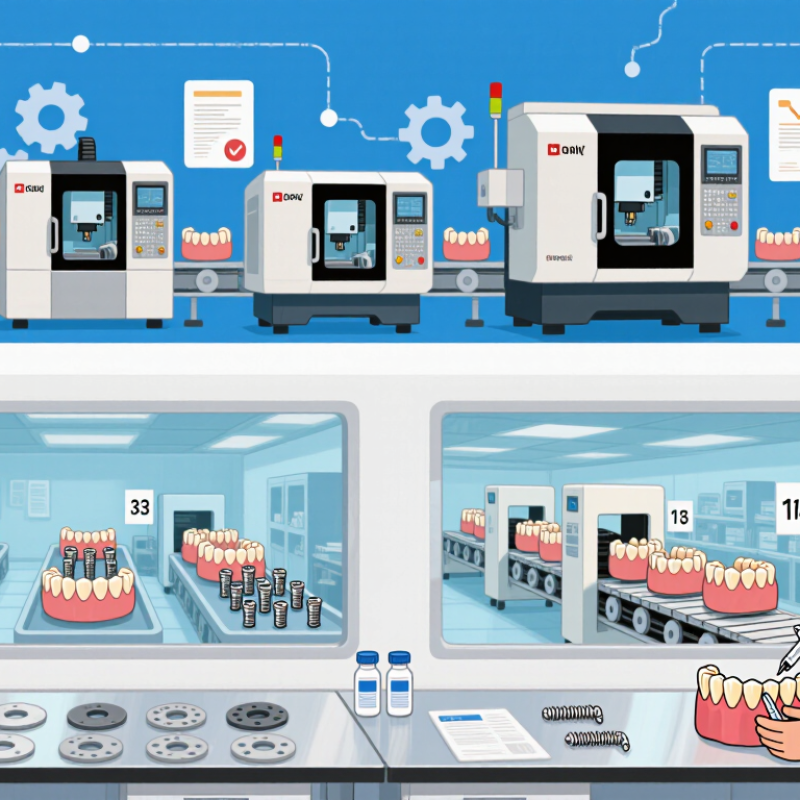
Precision dental manufacturing is the controlled production of dental components with tight dimensions, consistent materials, and documented quality checks. Its scope includes digital design, CAD/CAM processing, milling, additive manufacturing, finishing, inspection, and protective packaging. Products may include crowns, bridges, abutments, aligners, surgical guides, and custom frameworks.

The process begins with accurate digital files or physical impressions.

Technicians review margins, contact points, occlusion, and material requirements before production. During milling or printing, calibrated equipment helps maintain repeatable dimensions. Afterward, inspection may involve magnification, measurement tools, surface checks, and fit verification. A polished surface does not prove a precise fit. That detail is easy to miss.

For global buyers, the scope also covers traceability and technical communication.

Reliable suppliers should identify material lots, production dates, revision records, and inspection results. They should clarify tolerances, file formats, packaging conditions, and local documentation needs before accepting an order. Shipping distance can expose weak packaging or unclear labeling. Small errors become expensive delays.

Precision is not only a machine setting.

It depends on trained technicians, stable workflows, and honest communication when a design needs revision. Some production assumptions remain imperfect. A digital file may contain incomplete data, or a requested tolerance may not suit the material. Careful review is therefore part of manufacturing, not an optional extra.

Materials, Technologies, and Production Standards

What Is Precision Dental Manufacturing for Global Buyers?

Materials, Technologies, and Production Standards

Precision dental manufacturing combines medical-grade materials, digital design, and controlled production. Global buyers often select titanium, cobalt-chromium, zirconia, PMMA, or PEEK for different clinical needs. Each material behaves differently during milling, sintering, polishing, or sterilization. Zirconia can offer strong aesthetics, while titanium supports lightweight frameworks and durable implant components. Material certificates and lot traceability matter. They help buyers verify origin, composition, and production history.

Modern facilities use intraoral scans, CAD software, five-axis milling, and additive manufacturing. These tools reduce manual variation, but they do not remove it completely. Skilled technicians still inspect margins, contacts, occlusion, and surface texture. A crown may look accurate on a screen yet require adjustment on a physical model. That detail is easy to overlook. Production standards should include equipment calibration, validated procedures, incoming material inspection, and dimensional checks. Quality systems aligned with recognized medical-device standards can improve consistency and documentation.

Global buyers should request sample cases, inspection reports, and clear tolerance data before placing large orders. Ask how the manufacturer manages remakes, shade differences, and design revisions. A reliable supplier records each stage, from digital file approval to final packaging. Communication also needs structure. File naming, approval timing, and change control prevent costly misunderstandings. No process is perfect. Even careful production can face scanner errors, material variation, or human judgment. Honest reporting of these limits is more useful than promising zero defects.

What Is Precision Dental Manufacturing for Global Buyers? — Materials, Technologies, and Production Standards
Dimension Manufacturing Area Typical Materials or Technologies Relevant Technical Characteristics Common Production and Quality Standards Key Verification Documents for Global Buyers
Material Dental zirconia Yttria-stabilized tetragonal zirconia polycrystal, including 3Y-TZP and higher-translucency grades
  • High flexural strength compared with many glass-ceramic systems
  • Available in different translucency and strength grades
  • Requires controlled sintering to achieve the specified final dimensions
ISO 6872 for ceramic materials used in dentistry; validated milling and sintering parameters Material batch certificate, composition or grade information, sintering profile, inspection report, and lot traceability
Material Dental cobalt-chromium alloy Cobalt-chromium-based alloys for frameworks, copings, partial denture components, and metal-ceramic restorations
  • High corrosion resistance and stiffness
  • Suitable for cast, milled, or laser-sintered frameworks
  • Surface condition and alloy composition affect bonding and fit
ISO 22674 for metallic materials for fixed and removable restorations and appliances; applicable biocompatibility evaluation Alloy certificate, chemical composition, manufacturing route, heat-treatment record where applicable, and dimensional inspection data
Material Titanium and titanium alloys Commercially pure titanium and titanium alloys for implant components, bars, frameworks, and surgical or prosthetic parts
  • High strength-to-weight ratio and corrosion resistance
  • Often manufactured by CNC machining or metal additive manufacturing
  • Surface finish and cleanliness are critical at implant interfaces
Applicable implant, metallic-material, biocompatibility, cleaning, and sterilization requirements; ISO 13485 quality-system control Material grade certificate, build or machining record, surface-finish results, cleaning validation, and inspection report
Material Dental ceramics and glass ceramics Leucite-reinforced ceramics, lithium disilicate, feldspathic ceramics, and compatible veneering ceramics
  • Designed for esthetic restorations and controlled optical properties
  • Performance depends on processing, crystallization, glazing, and firing conditions
  • Shade reproducibility requires calibrated lighting and measurement procedures
ISO 6872 for ceramic materials used in dentistry; documented firing and crystallization cycles Material certificate, shade or optical specification, firing records, lot number, and final visual or instrumental inspection
Material Polymeric materials PMMA, composite resin, thermoplastic polymers, denture-base materials, and CAD/CAM resin blanks
  • Used for provisionals, denture bases, try-ins, splints, models, and selected definitive applications
  • Properties vary by polymer type, degree of conversion, and processing method
  • Water absorption, residual monomer, wear, and dimensional stability may require evaluation
ISO 20795 for denture base polymers where applicable; ISO 4049 for polymer-based restorative materials where applicable Material safety data, technical data sheet, batch certificate, curing or polymerization record, and biocompatibility documentation
Technology CAD/CAM design Digital order intake, dental CAD modeling, nesting, virtual articulation, and automated design-rule checks
  • Supports repeatable digital workflows from scan data to production
  • Requires defined minimum thickness, connector, margin, and compensation rules
  • File formats commonly include STL, OBJ, and PLY, depending on the workflow
Validated software workflow, controlled design libraries, revision control, and documented design acceptance criteria Approved design file, software version, manufacturing instructions, revision history, and customer approval record
Technology Subtractive manufacturing Five-axis CNC milling, precision turning, grinding, polishing, and finishing
  • Suitable for zirconia blanks, titanium, cobalt-chromium, PMMA, and selected glass ceramics
  • Dimensional capability depends on machine calibration, tooling, material, geometry, and fixturing
  • Tool wear and coolant control can influence surface quality and fit
Machine calibration, preventive maintenance, tool-life monitoring, process validation, and final inspection Machine calibration records, tool management records, in-process inspection results, and final conformity report
Technology Metal additive manufacturing Laser powder bed fusion for selected cobalt-chromium and titanium dental components
  • Enables complex geometries and efficient framework production
  • Part quality depends on powder condition, energy parameters, build orientation, support design, and post-processing
  • Stress relief, support removal, machining, and surface treatment may be required
Validated build parameters, powder control, equipment qualification, post-processing control, and ISO 13485 documentation Powder batch record, build file, machine and parameter log, post-processing record, dimensional report, and material testing where required
Technology Resin additive manufacturing Digital light processing or stereolithography for models, surgical guides, splints, try-ins, and selected appliances
  • Resolution and accuracy depend on layer height, optical calibration, orientation, support strategy, and post-curing
  • Medical or dental intended use must match the resin's validated indication
  • Cleaning and post-curing are essential for consistent final properties
Applicable material standard, validated cleaning and post-curing process, equipment calibration, and biocompatibility assessment Resin lot record, printer and parameter log, post-curing record, cleaning validation, intended-use statement, and inspection report
Quality Dimensional accuracy and fit Inspection by calibrated optical scanners, coordinate measuring machines, gauges, or verified digital comparison
  • Acceptance limits should be defined according to the restoration, interface, material, and approved drawing
  • Critical areas may include margins, implant interfaces, contacts, occlusal surfaces, and connector dimensions
  • Accuracy claims should identify the measurement method and sampling plan
ISO 13485 quality controls; ISO 14971 risk-based controls where the product is a medical device; documented measurement-system verification Inspection plan, calibrated-equipment certificates, measurement report, nonconformance record, and corrective-action documentation where applicable
Quality Surface finish and cleanliness Polishing, blasting, electropolishing, ultrasonic cleaning, and controlled packaging
  • Surface roughness and residual particles can affect fit, hygiene, wear, bonding, and tissue response
  • Implant-contacting and patient-contacting surfaces require clearly defined cleaning controls
  • Visual inspection alone may not verify all cleanliness requirements
Validated cleaning process, contamination-control procedures, applicable biocompatibility evaluation, and controlled packaging Cleaning validation, surface-finish report, particle or residue-control results where required, packaging specification, and release record
Safety Biocompatibility and chemical safety Evaluation of patient-contacting materials, residues, extractables, leachables, and processing by-products
  • Assessment depends on the nature and duration of patient contact
  • Material safety cannot be established solely from a supplier declaration
  • Finished-product processing may introduce residues not present in the raw material
ISO 10993 series as applicable to the contact type and duration; ISO 14971 risk-management principles Biological evaluation plan or report, material safety data, chemical characterization where applicable, and risk-management file summary
Regulatory Quality management system Documented controls for design, purchasing, production, inspection, release, complaints, and corrective actions
  • Provides traceability across materials, equipment, operators, software, and finished products
  • Supplier qualification and change control are important for cross-border supply
  • Quality records should be retained for the period required by the applicable market
ISO 13485 is the internationally recognized quality-management standard for medical devices Quality certificate scope, audit summary, process map, supplier-control procedure, change-control procedure, and complaint-handling process
Regulatory Risk management Hazard identification, risk estimation, risk control, verification, and production or post-production monitoring
  • Risks may include fracture, incorrect fit, contamination, material mix-up, data error, and inadequate labeling
  • Controls should be linked to measurable acceptance criteria
  • Risk documentation should reflect the final product and manufacturing process
ISO 14971 risk-management framework for medical devices Risk-management plan, hazard analysis, FMEA or equivalent assessment, verification evidence, and residual-risk evaluation
Global Supply Packaging, labeling, and traceability Protective packaging, product identification, lot or serial numbering, digital order records, and shipping documentation
  • Packaging should protect the product from deformation, contamination, moisture, and damage during transport
  • Labels should identify the product, material, quantity, lot or serial number, and applicable handling information
  • Country-specific labeling and import requirements may vary
ISO 15223-1 symbols where applicable; ISO 20417 information supplied by the manufacturer where applicable; market-specific regulatory requirements Packaging specification, label artwork, packing list, certificate of conformity, lot traceability, and shipping-condition records
Buyer Control Incoming and final acceptance Sample inspection, 100% visual checks for critical features, digital file verification, and certificate review
  • Acceptance criteria should be agreed before production begins
  • Critical-to-quality characteristics should have defined inspection methods and sampling levels
  • Nonconforming products require segregation, documented disposition, and corrective action where appropriate
Approved inspection plan, documented release criteria, measurement-system controls, and nonconformance procedures Purchase specification, approved drawing or design file, inspection report, certificate of conformity, and deviation-approval record

Design and Customization for Global Dental Buyers

What Is Precision Dental Manufacturing for Global Buyers?

Design and customization guide successful dental manufacturing for international buyers. A precise restoration begins with clear clinical information, not machinery alone. Teams review intraoral scans, preparation margins, occlusion records, shade references, and the intended delivery date. Missing details create avoidable revisions.

Customization also requires practical communication. Buyers may request a specific emergence profile, contact point, thickness, or surface texture. Experienced technicians convert these preferences into measurable design instructions. They also check whether the requested form suits the selected material and clinical application. A beautiful design can still fail if it ignores function.

Small details matter.

For global orders, reliable manufacturers should provide traceable production records, inspection images, and consistent packaging procedures. Dimensional checks can confirm margins, connector sizes, and seating surfaces before dispatch. Material documentation and quality records help buyers meet local professional requirements. These documents should be clear, current, and easy to verify.

No workflow is flawless. A scan may contain distortion, or a shade photo may show misleading lighting. I have seen projects delayed because teams assumed rather than confirmed. A short design review often prevents expensive remakes. Buyers should ask about revision limits, approval stages, communication time zones, and handling of unexpected findings. Precision is not only a tight measurement. It is a disciplined exchange between clinical intent, technical judgment, and accountable customization.

Quality Control, Certifications, and Regulatory Compliance

What Is Precision Dental Manufacturing for Global Buyers?

Precision dental manufacturing is more than tight tolerances and clean machining. It requires documented quality control from design transfer to final shipment. The World Health Organization’s Global Oral Health Status Report (2022) estimates that nearly 3.5 billion people live with oral diseases. That scale increases the need for reliable, traceable dental components.

Buyers should check whether the manufacturer operates under ISO 13485 and uses risk controls aligned with ISO 14971. The FDA’s Quality Management System Regulation, effective in 2026, aligns U.S. requirements more closely with ISO 13485. For European distribution, Medical Device Regulation documentation may also be necessary. Ask for material certificates, inspection records, calibration dates, nonconformance reports, and batch traceability. A certificate alone proves little.

Quality becomes visible in small details.

Tips: Request a sample device history record before placing a large order. Confirm measurement methods, acceptance limits, and inspection frequency. Ask how supplier changes are approved. Do not rely only on a polished audit report; production evidence matters more. In practice, one missing calibration signature can create unnecessary regulatory questions. Even experienced teams overlook this. Buyers should also review sterilization evidence, packaging validation, and complaint-handling procedures when applicable. These records help connect technical performance with patient safety, while revealing weak controls before they become expensive problems.

Sourcing, Shipping, and Supplier Evaluation Factors

Precision dental manufacturing is not only about tight tolerances. Global buyers must control sourcing, shipping, and supplier evidence from the first quotation. The WHO Global Oral Health Status Report (2022) estimates that oral diseases affect nearly 3.5 billion people worldwide. That demand increases pressure on manufacturers, but volume should never replace verification.

Ask suppliers for material certificates, dimensional inspection records, process validation, and batch traceability. ISO 13485 certification is useful, yet a certificate alone proves little. Review its scope, expiration date, audit history, and corrective-action records. Request samples from regular production, not a specially prepared batch. Measure fit, surface finish, and packaging condition independently. Small gaps can become expensive clinical problems.

Shipping deserves equal attention. The World Bank’s Logistics Performance Index 2023 evaluates 139 economies through customs, infrastructure, shipment arrangements, logistics quality, tracking, and timeliness. Use these factors when comparing production locations. Confirm Incoterms, export documents, tariff codes, insurance, and delivery responsibilities in writing. Packaging should protect delicate components from vibration, moisture, and contamination. Include photos of sealed cartons and humidity indicators. It sounds basic. It is often missed.

A practical supplier audit should examine calibration logs, operator training, nonconforming-product controls, and complaint response times. Ask how many days a corrective action normally takes. The answer may reveal more than a polished presentation. I would also test a small order before committing to annual volume. That adds time, but rushed approval is a recurring sourcing mistake. Supplier performance should be reviewed after delivery, not only before purchase.